Where it started.
The union collected harvest forecasts through phone calls and notebooks. Buyers received rough volumes, collection was poorly planned, and part of the onion and carrot crop was lost because it was never picked up.
The challenge
Collect reliable information from growers who prefer speaking to writing, then turn it into a workable collection plan.
- Growers more comfortable speaking than writing.
- Basic phones for some members.
- Human review of every volume before any commitment to buyers.
- Data that remains the union’s property.
What we built.
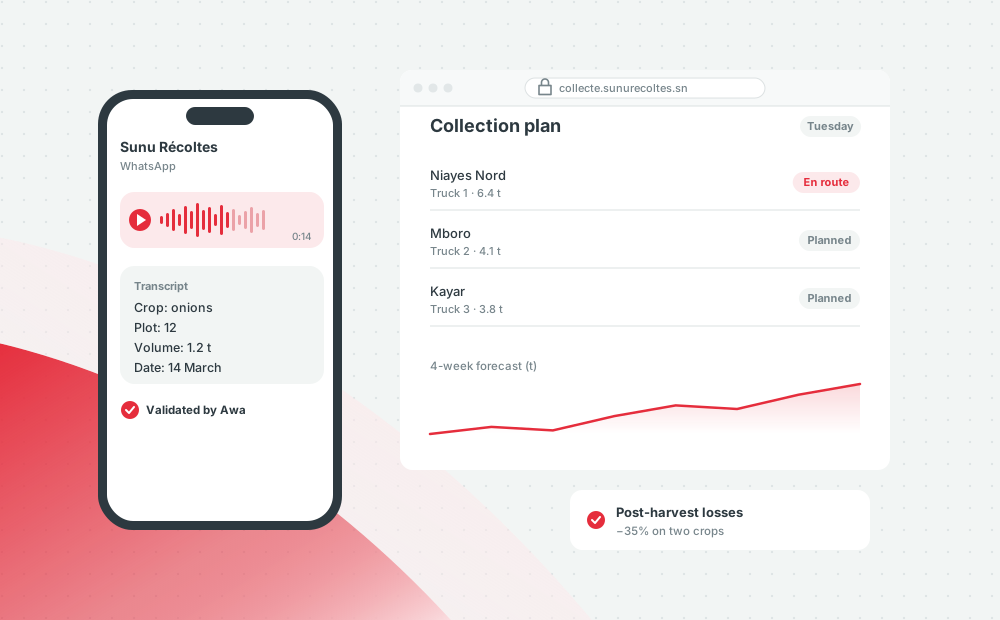
An assistant available on WhatsApp and by voice line: the grower speaks in Wolof, and the model transcribes and extracts the crop, plot, volume and date. A field coordinator validates each report, then the platform proposes a collection plan and an indicative price based on past data.
- Voice reporting in Wolof via WhatsApp or a voice line.
- Transcription and volume extraction, validated by a coordinator.
- Collection plan by area and by truck.
- Volume forecasts and indicative prices from the union’s history.
- Audit log of every AI suggestion.
How the project ran.
- 01
Scoping. Choosing one measurable use case first: the harvest report.
- 02
Data. A set of 900 voice messages annotated with the union’s coordinators.
- 03
Evaluation. Accuracy tests by crop and by accent before launch.
- 04
Launch. Rollout over two seasons, with a monthly error review.
What changed.
Indicators tracked after launch.
-35%
post-harvest losses on the two crops tracked
94%
of voice reports correctly extracted
2 days
to pick-up, down from six
What made the difference
The AI never decides alone. Every volume is validated by a coordinator, which built trust with growers and buyers alike.
Technologies
Speech-to-text · LLM · Python · PostgreSQL · WhatsApp Business API · IVR